

The Minimal Phonic Cues Website
Fundamentals of Minimal Phonic Cues
Minimal Phonic Cues (MPC) is an easily-learnt and simple method of learning to read for young students and adults.
Background
Margaret Sanders, formerly a Senior Lecturer in the Education Department of Wolverhampton Polytechnic, first devised the MPC reading system in the early 1970s. click here to read more about Margaret.
Initially, the MPC system was tried on a small scale, with about ten groups of students of varying ages. The experiments proved highly successful and Mrs Sanders published several articles about her new scheme in the educational Press. These resulted in widespread interest. By 1975 MPC had been tested successfully in a large number of schools both in the UK and overseas.
In January 1976 a questionnaire was sent to a cross-section of those teachers who were using the scheme. It was their positive and enthusiastic responses which prompted Mrs Sanders to consider publishing her scheme as a complete teaching system.
"My hope is that, when it is on the internet, it will be available to anyone who needs it."
Margaret Sanders (author) talking about MPC. 2005.
Advantages of MPC
- Regularises every spelling, covers all phonic sounds and can be adapted to suit regional differences in pronunciation.
- Easy to use with any reading material.
- Suitable for children and adults.
- Encourages students to learn quickly, because success is immediate.
- Based on normal spelling. There is no problem when children change schools. MPC is easily discarded when no longer necessary.
- Quick and simple to correct. Students soon learn to correct themselves.
- No need to invest in any new or expensive materials click here to read some testimonials
What this website has to offer
This website has been designed to be a complete resource for the learning and application of MPC for the teacher and the individual. Within this site is contained the complete Teacher's Book which provides a total course in the development and application of MPC. In addition, the resources section contains the previously published MPC Reading and Spelling Workbooks, the MPC Word List, and plenty of back-up material including reading books, flashcards, and interactive activities to assist in the teaching and learning of MPC. All resources are readily downloadable at no-charge. It is advised that users first read the introduction to MPC, situated below, and then proceed to the resources section to familiarize with the content of MPC.
Introduction to MPC
The principles of MPC are so simple that students soon learn to recognise and apply them. Once the theory has been grasped, success follows instantly. MPC is based entirely on normal English spelling and can be used to regularise any word. Each of the 45 main phonic sounds is carefully defined, in letters and pictures, on a basic Cue Card (see right pane). Easy-to-recognise symbols placed over letters indicate correct pronunciation and a cross indicates silent letters (see below example). When there is no appropriate symbol, straightforward substitution is used. Any word can be successfully ‘decoded’, even if the spelling is confusing
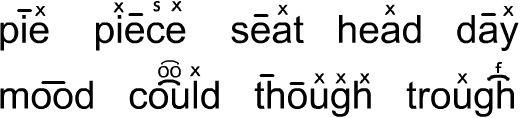
Fig: Example of text with symbols to indicate pronunciation.
MPC is especially suitable for adults who have problems with reading. This is because MPC does not rely on any new letter forms, so it can be applied to any existing reading matter. For this reason the scheme is also particularly helpful for students who need to improve their spelling, as words remain consistent throughout. Due to the flexibility of the system regional differences can also be easily encompassed. Detailed notes as to how to adapt the system to suit regional differences in pronunciation, for helping with spelling and the modification of the system for adults are included in the Teacher’s Book.
One of the most frequent problems faced by teachers, working with both children and adults, is a lack of interest or boredom at the early learning stages. MPC is designed to overcome this difficultly. Firstly, because of the element of instant success, and secondly by providing a variety of suggestions for games, activities and other teaching aids to help stimulate and retain the students’ interest. The scheme is a great benefit to busy teachers working with large classes.
Please proceed to the resources section to familiarize with the content of MPC.